Get it — container
No install, nothing on the host.
$ docker run --rm -v "$PWD:/data" \
mancube/shapeshift \
infer -i /data/events.jsonl
Apache-2.0 · one static binary · v0.5.0
shapeshift streams JSON and JSONL into Parquet or a self-contained Apache Iceberg v2 table under one small declarative spec. No JVM, no catalog server, no Python, no row cap, no telemetry — and peak memory that does not move when the input grows eight hundred times.
events.jsonl — nested, ragged, untyped
{"id": 1, "user": {"name": "Ada", "plan": "pro"},
 "amount": 12.50, "day": "2026-07-13",
 "tags": ["a","b"], "active": true}
{"id": 3, "user": {"name": "Linus"},
 "amount": 99.99, "tags": ["x"], ...}
not-json-a-bad-line
{"id": 4, "user": {"name": "Edsger", ...},
 "amount": 0, "active": true}
events.parquet — flat, aligned, typed
active     Boolean
amount     Float64
day        Date32
event_at   Timestamp(Microsecond, None)
id         Int64
tags       Utf8
user.name  Utf8
user.plan  Utf8
Nested objects flatten to dotted columns. YYYY-MM-DD is detected as
DATE, RFC3339 as TIMESTAMP(µs), arrays land as a
JSON-encoded leaf. The un-parseable line is counted and written to a reject
sidecar — it does not abort the run and it is not silently dropped.
§01 — how to use it
Every block below is real output from the shipped
examples/events.jsonl — four good records and one line
that is deliberately not JSON.
01
Infer a spec from a sample
Point it at a file. It prints a ready-to-edit YAML spec — the columns, types and coercion policy it would use. This is the governance surface: write it once per source shape, review it, diff it in a pull request.
02
Shape it
With no --spec it infers on the fly. The bad line is counted, not fatal, and its raw text is preserved in a sidecar with the line number and the parser's error.
- is standard input, and the source is read once, so cat x.jsonl | shapeshift shape -i - -o out.parquet shapes exactly what the file would.
03
Inspect it — footer only, no data scan
04
Or land an Iceberg v2 table instead
Same input, same spec, one flag. The table directory is self-contained — data, manifest, manifest list, table metadata and a version hint. No catalog server is needed to write it or to read it.
Get it — container
No install, nothing on the host.
Get it — binary
A shapeshift-v* tag builds an x86_64-unknown-linux-musl binary, asserts it is statically linked and boots, and attaches it with a .sha256 to the GitHub release.
Get it — source
One file, no runtime deps.
§02 — measured, not claimed
Every number on this page comes from
benchmarks/bench.py — python3 stdlib and cargo, no other
dependencies. Datasets are generated by a deterministic formula, and every
child process is measured with per-child ru_maxrss. Run it on
your hardware and compare.
14.1 MiB
Peak RSS shaping a 1,260 MB input — 8 million rows.
~820×
Input growth across the sweep, for a 1.4× move in peak memory.
273k rows/s
Steady from 1M to 8M rows on the shipped musl binary.
3.0 ms
Median cold start — exec to four rows shaped to exit.
| bench | rows | input | wall | rows/s | peak RSS |
|---|---|---|---|---|---|
| jsonl→parquet | 10,000 | 1.5 MB | 0.06s | 157,980 | 9.9 MiB |
| jsonl→iceberg | 10,000 | 1.5 MB | 0.06s | 163,567 | 9.9 MiB |
| jsonl→parquet | 1,000,000 | 157 MB | 3.85s | 259,769 | 12.3 MiB |
| jsonl→iceberg | 1,000,000 | 157 MB | 3.84s | 260,646 | 12.4 MiB |
| jsonl→parquet | 8,000,000 | 1,260 MB | 29.3s | 273,495 | 14.1 MiB |
| jsonl→iceberg | 8,000,000 | 1,260 MB | 29.7s | 269,506 | 14.1 MiB |
Machine: Intel Xeon @ 2.80 GHz (4 cores), 15.7 GiB RAM · rustc 1.94.1 · release build · shipped musl-static binary (~4.0 MB, stripped). One stated machine — evidence that the design property holds, not a promise about yours.
The flat curve is what the row-group == batch design promises: the
shaper flushes a RecordBatch every row_group_rows
(default 50,000) and the sink closes that row group immediately, so memory
is bounded by the row group rather than the input. The Iceberg path costs
almost nothing over Parquet, because it is the Parquet writer plus a
metadata tail.
MALLOC_MMAP_THRESHOLD_=65536 on the same glibc binary is flat at
16 MiB. Pick your binary by what you are optimising for. The harness
measures both.
§03 — the work behind the number
The same sweep on the same machine, at 8 million rows. Each step is A/B'd in the benchmark document, and the earlier rows are kept as measured rather than quietly restated.
| step | what changed | rows/s, musl, 8M |
|---|---|---|
| baseline | allocating three times per row | 121,185 |
| step 1 | removed the per-row allocations | 149,649 |
| step 2 | overlapping the writer — no gain on musl at the time | 149,649 |
| step 3 | parsing onto a reusable tape | 273,495 |
The record model used to be a serde_json::Value — a tree of
small heap allocations, one map per object and a string per key, built and
thrown away for every record. It now parses onto a reusable simd-json
tape: a flat vector of nodes whose strings point back into the read
buffer. In the steady state nothing is allocated per record.
Read the gap as well as the rows. Parsing 1M records, the owned model is 2.1× slower on musl than on glibc; the tape only 1.16×. With nearly nothing to allocate, the allocator nearly stops mattering — which is why this, and not a different allocator, was the answer.
| parse only, 1M records | glibc | musl |
|---|---|---|
owned serde_json::Value | 540k rec/s | 256k rec/s |
| borrowed value | 855k rec/s | 488k rec/s |
| tape, reused buffers | 1,849k rec/s | 1,592k rec/s |
Values across. It measured about 2× slower than
single-threaded on both targets — 0.47× on glibc, 0.54× on
musl. A Value is a tree of small allocations, so shipping one
across means every record is allocated on one core and freed on another. An
Arrow RecordBatch is the opposite shape: a few large contiguous
buffers behind an Arc. What crossed the boundary mattered
far more than whether anything did.
Output never changed through any of this: the shaped Parquet is byte-identical
across the pipeline flag and across both record models, on both targets, and
tape_and_serde_agree_on_every_accessor asserts the two readers
answer identically. It caught two real divergences — simd-json's
as_f64 refuses an integer node, so 3 in a
float64 column would have been written as null.
§04 — the correctness edge
Iceberg has a sharp edge: the field-id chain. A table can look
completely well-formed and still fail to open, and that failure is the whole
reason this write path exists.
The general Rust Avro crate drops the field-id attributes on the
manifest schema. A reader then hits
No default expression in FieldId Map and the table is dead. So
shapeshift emits the Avro Object Container File itself — a roughly
150-line hand-rolled encoder — specifically to preserve them, and the
data Parquet carries PARQUET:field_id 1..N to match. There is no
Avro crate in the dependency tree at all.
The acceptance gate is an engine we did not write. DuckDB 1.5.4 reads
both paths and returns the same rows and the same aggregates — four
rows, sum(amount) = 115.49, identical from
read_parquet() and iceberg_scan().
Self-contained
Each run writes the data files, manifest, manifest list, v{N}.metadata.json and a version hint. No catalog service to produce it or to read it.
Multi-snapshot
--append adds a snapshot to an existing table, with per-column manifest statistics.
Partitioned
--partition-by takes identity columns and the hidden transforms bucket, truncate, year, month, day and hour — one data file per partition value under Hive-style directories.
C-free by default
parquet is built Snappy-only, so no zstd or brotli C codecs are linked. That is what keeps the binary musl-static. --features zstd is the one sanctioned exception — it writes 11 MB against Snappy's 20 MB on the same 1M rows, for about 2% more wall time.
§05 — since 0.1
0.2 stopped schema drift passing silently. 0.3 made a table something you can upsert into. 0.4 is the hygiene that keeps a merged-into table cheap to read and safe to write from several places at once. 0.5 lets a table move, and commit through an Iceberg REST catalog.
0.37 s
Merging 100,000 rows, half of them updates, into a 1M-row table. Appending them: 0.14 s.
71→9 ms
A DuckDB scan after 30 daily merges, then after one 0.7 s compact. Before any merge: 7 ms.
10.3 MiB
The same table on disk after expire, from 27.1 MiB compacted with its history.
75
Exit status of a writer the commit guard refused. Nothing it wrote was published. Run it again.
| release | what it added |
|---|---|
| 0.2.0 | Schema drift detection, on by default: warn, rescue, quarantine, error, ignore |
| 0.2.0 | -i - reads standard input once; unknown spec keys are refused |
| 0.3.0 | --merge-on: upsert by key with Iceberg v2 position deletes, local and object store |
| 0.4.0 | compact and expire, the commit guard, --summary-json |
| 0.4.0 | Object-store tables read and write 8 files at a time; a small file is one request |
| 0.5.0 | relocate: a copied or moved table is re-anchored, so any engine reads it with no flag |
| 0.5.0 | --catalog: commit through an Iceberg REST catalog, with a bearer token or OAuth2 client credentials (an object_store build) |
| 0.5.0 | A where row filter, --run-id so a retry never appends twice, and writing into tables other engines made |
Merge, compaction and expiry figures: 4 vCPU Intel Xeon @ 2.10 GHz, glibc release build, DuckDB 2.0 as the reader. One stated machine, from BENCHMARKS.md §7, like everything else here.
A merge is merge-on-read: the delta lands as new data files and every row it supersedes is removed with a small position-delete file. No existing data file is rewritten, and the merge reads only the key columns of files whose manifest bounds could hold a match. Every Iceberg v2 reader applies the deletes; DuckDB's is checked against a plain-Python model after every merge, compaction and expiry.
A commit creates the next metadata.json only if no other writer did
— a hard link locally, a conditional put on S3, GCS and Azure. Four writers
merging into one table while a janitor compacts and expires it lose nothing. The
same race on a build without the guard lost 400-odd of about 580 rows whose
writers had been told they committed.
--on-drift ignore buys it back.
§06 — see what happened
shapeshift serve is a local web console in the same binary: infer and
edit a spec, shape, inspect — and, new in 0.5, every run and every table’s
history. Click a screenshot to enlarge it.
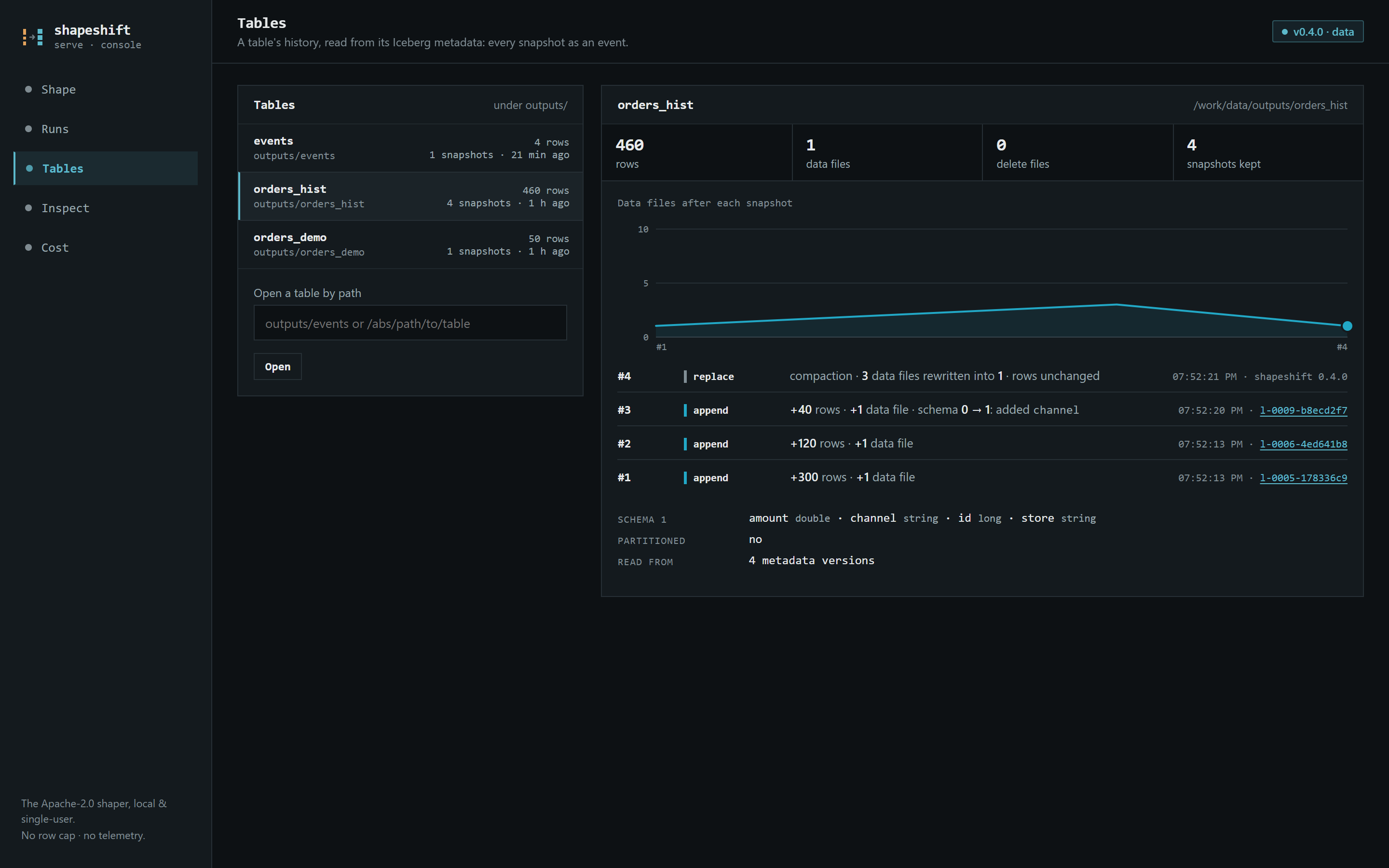
serve · Tables new in 0.5
Left: the Iceberg tables under outputs/, with rows, snapshots and
age, and a box to open any table by path. Right: the selected table’s
figures (rows, data files, delete files, snapshots kept), its data files after each
snapshot, then every snapshot as an event, newest first — append,
overwrite for a merge, replace for a compaction — with
schema changes and a link to the run that wrote it. Read straight from the
table’s own metadata.
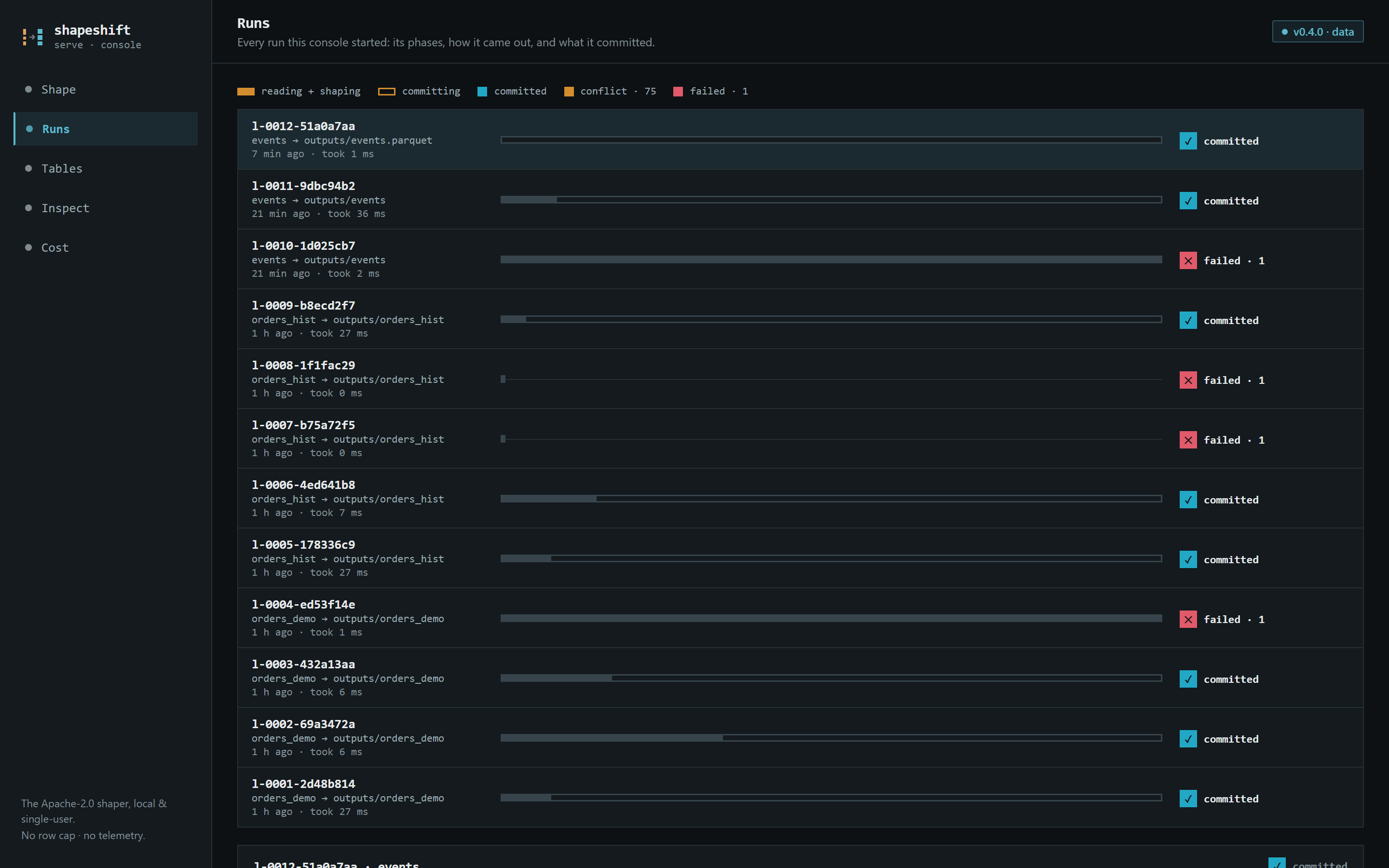
serve · Runs new in 0.5
One row a run, newest first. Left: the run id (the same id is recorded in the snapshot it commits), the dataset and where it wrote, when and how long. Middle: a bar for its phases, reading + shaping then committing. Right: how it came out — committed, conflict (exit 75: another writer moved the table first, nothing published) or failed (exit 1). The legend sits above.
In development · not yet released A separate, self-hosted product around the same engine: a control plane that runs datasets on worker pools in your own clusters, keeps the Iceberg catalog, and tells you what needs a look. The engine above stays open source and complete on its own.
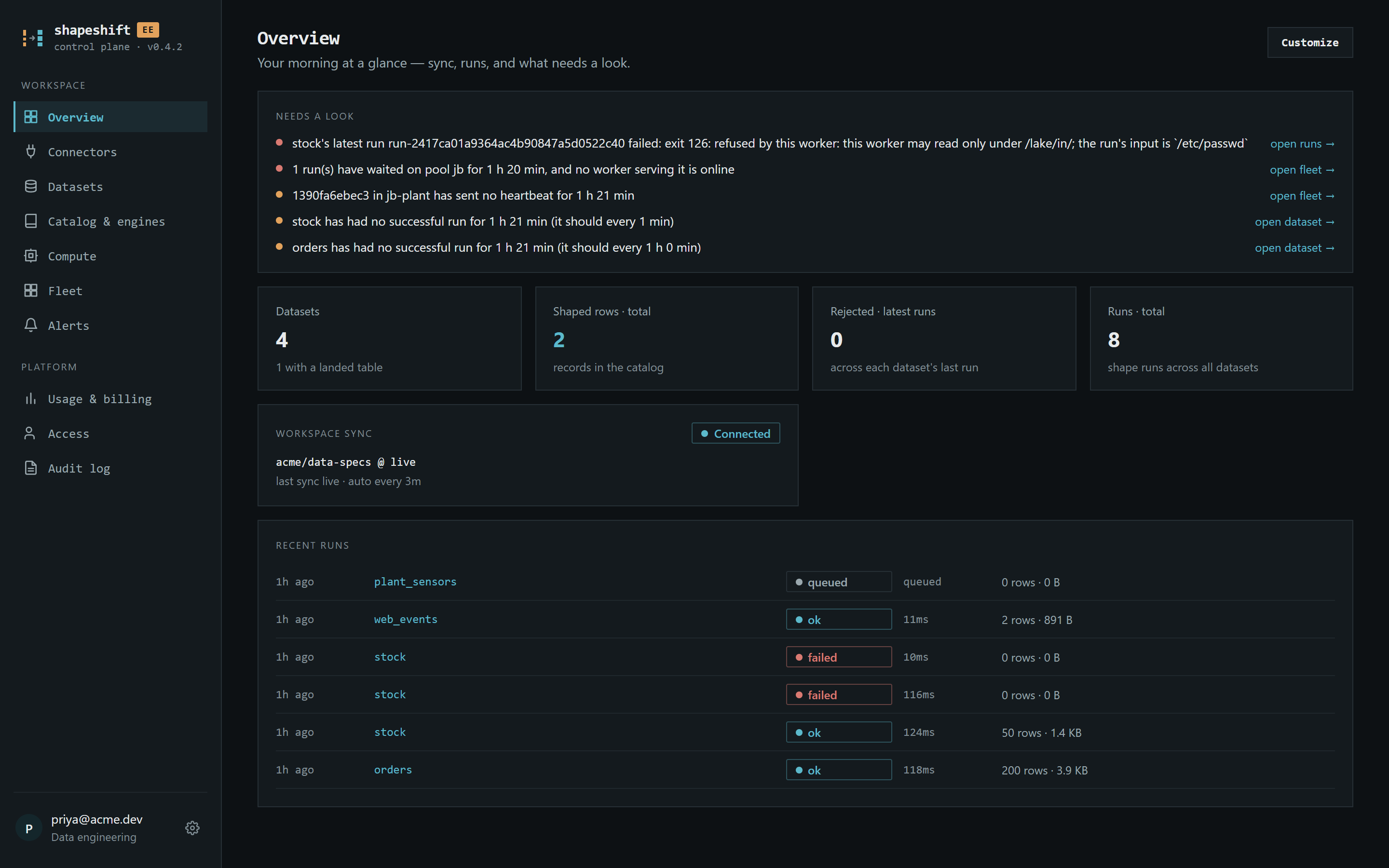
EE · Overview
Sidebar (every page): the mark with its EE pill, then Workspace pages (datasets, catalog, compute, fleet, alerts) and Platform pages (usage, access, audit). Top: “needs a look” — a failed run, a pool with runs waiting and no worker, a silent worker, a stale table — each linking to where you act. Below: workspace figures and the recent runs across datasets.
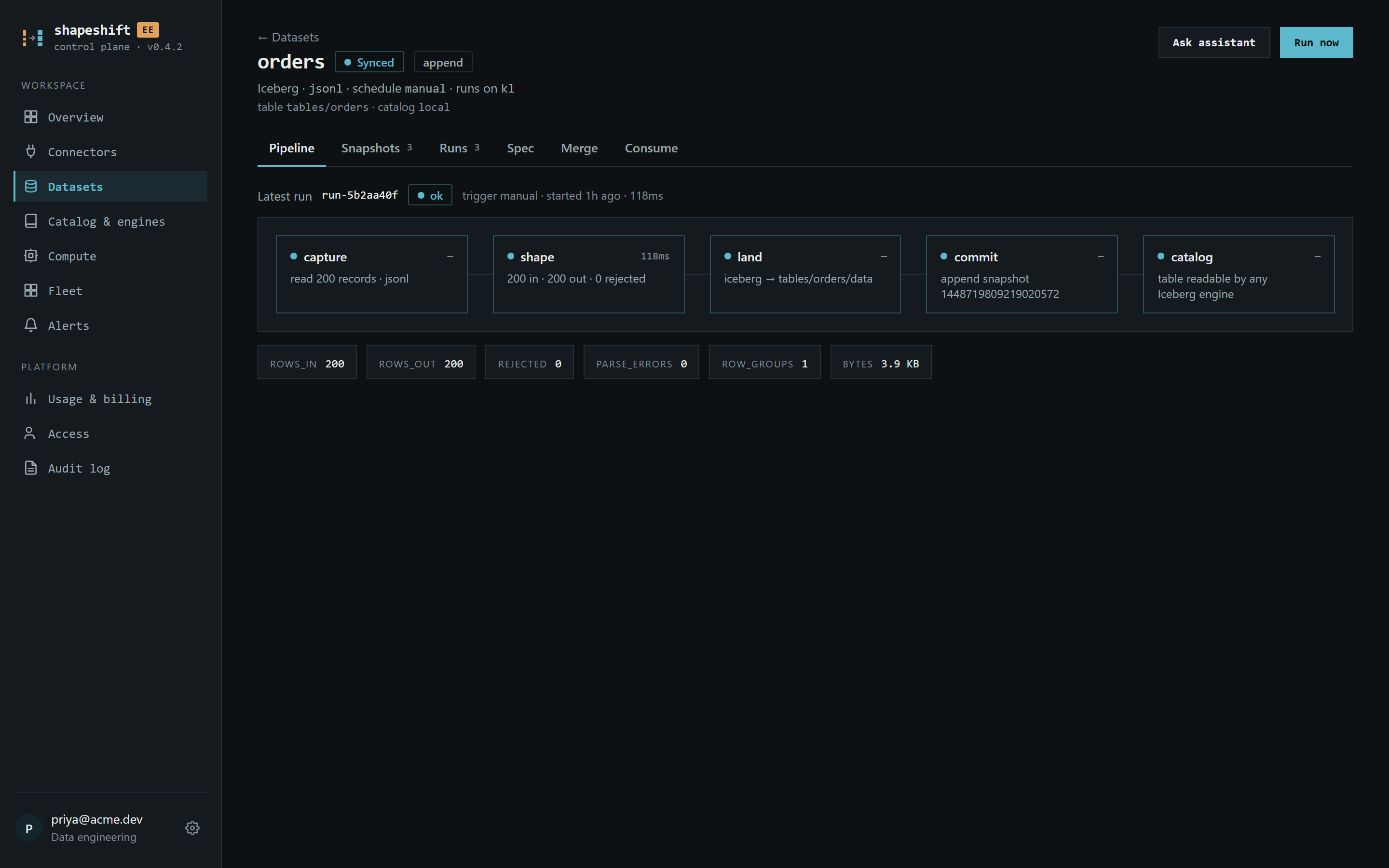
EE · a dataset
Header: the dataset’s status, format, schedule and the pool it runs on, with Run now. Tabs: Pipeline, Snapshots, Runs, Spec, Merge, Consume. Pipeline: the latest run as five steps — capture, shape, land, commit, catalog — each with its outcome (a failed step says why), then the run’s counts.
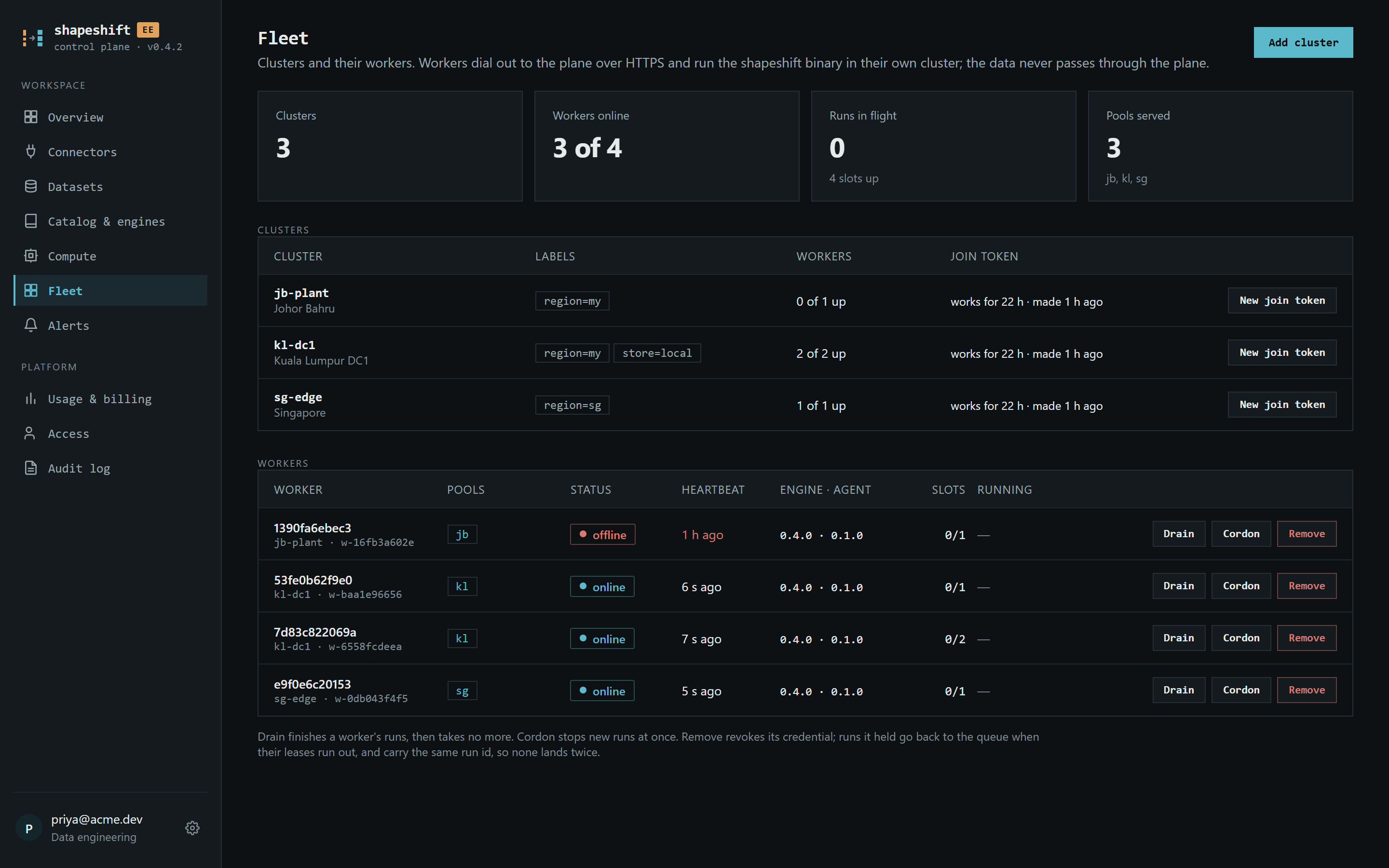
EE · Fleet
Top: clusters, workers online, runs in flight, pools served. Clusters: where each runs, its labels, workers up and its join token. Workers: pools, status, heartbeat, engine and agent versions, slots and the runs held, with Drain, Cordon and Remove. Workers dial out to the plane; the data never passes through it.
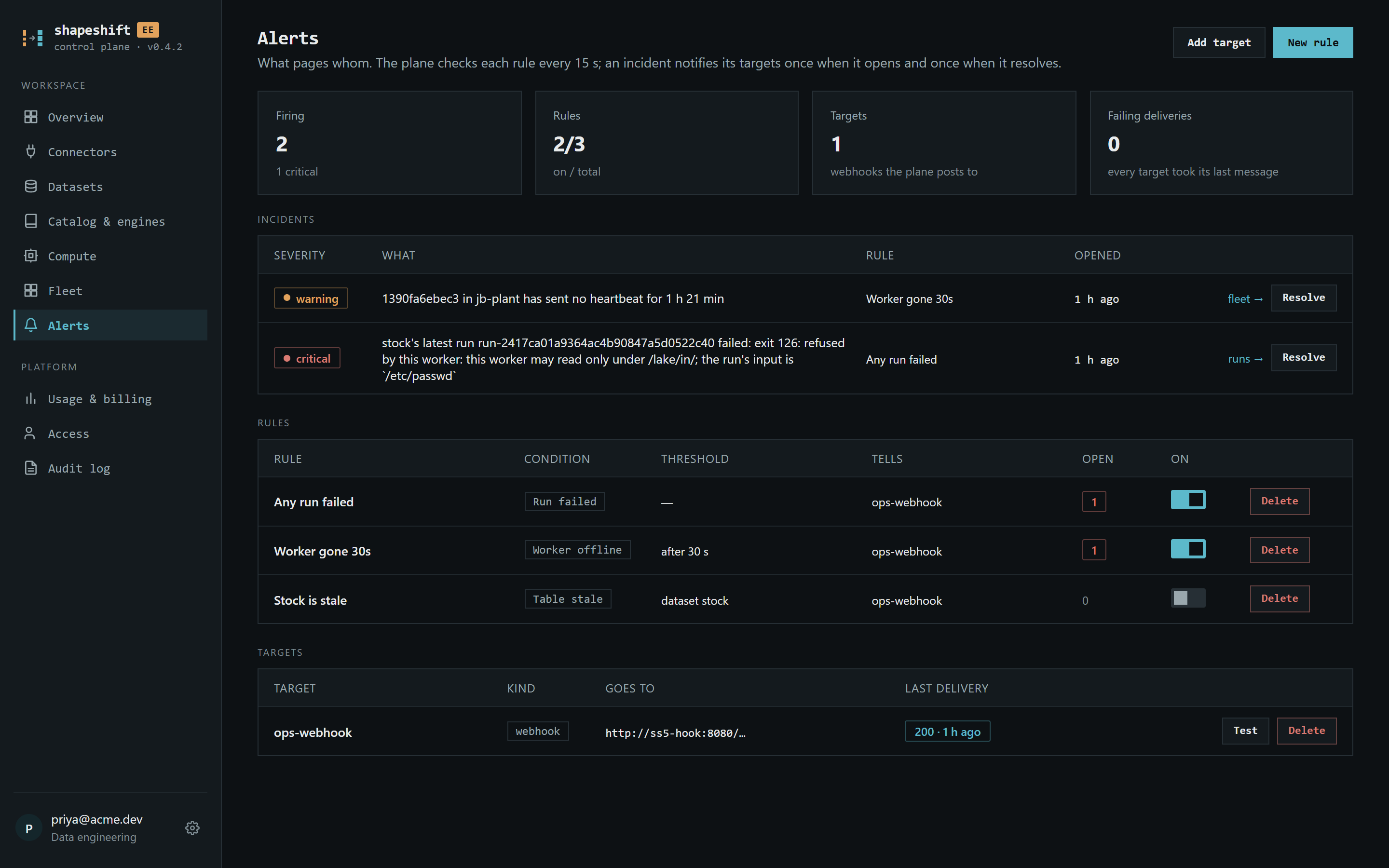
EE · Alerts
Top: what is firing, rules on, targets, failing deliveries. Incidents: severity, what, the rule, when — resolve by hand or follow the link. Rules: condition, threshold, who it tells, on/off. Targets: webhooks with their last delivery and a Test button. An incident notifies once when it opens and once when it resolves.
§07 — where it loses
It is the transform-and-land layer, not the movement layer. It owns one job: turn semi-structured JSON into a governed columnar table from a spec you can read and diff. Here is where the incumbents are simply better.
| capability | shapeshift | Fivetran / Airbyte | dlt | Spark / PyIceberg |
|---|---|---|---|---|
| Runtime | one static binary | managed service | Python library | JVM / Python |
| Connector breadth | none | hundreds — best | growing | ecosystem-wide |
| Incremental / CDC today | upserts a delta; no capture | yes | yes | yes |
| Managed catalog | no | yes | via engine | best |
| Billing model | no row cap, no telemetry | MAR / credit | self-run | self-run |
| Iceberg v2 write, field-ids | yes, no catalog | managed dest | emerging | best |
| Declarative transform spec | yes — the boundary | partial (SQL) | code | code |
| Bounded-RAM streaming | yes | managed | yes | cluster |
If your problem is “reliably pull from 40 SaaS APIs”, a managed ELT vendor wins outright and shapeshift is not in the running. If your team lives in Python and wants pipelines-as-code, dlt is a joy. If you need a managed catalog across an estate, that is Spark and PyIceberg's home ground.
Be precise about schema drift too. shapeshift detects drift within a run — undeclared fields, values that stopped coercing — and gives you five ways to handle it. What it does not do is manage the schema over time: propagate an added column on the next scheduled sync, keep a drift history, alert on it. That is stateful cross-run work. The honest summary is that shapeshift makes drift visible and survivable; a managed vendor makes it someone else's problem.
§08 — the economics, without the sales pitch
Managed ELT bills by Monthly Active Rows: every distinct key inserted, updated
or deleted, on a tiered curve. Re-touching the same rows pays again.
shapeshift cost makes the trade arithmetic instead of rhetoric
— and it never guesses a vendor price. You supply your plan's
effective rate.
The negative number is not a bug. It is the point: the tool shows you when self-hosting does not pay, rather than selling you a figure.
Apache-2.0
The engine is open source, complete on its own, and has no row cap and no phone-home. Read it before you run it.
Not an orchestrator — that is dagron. Not a connector catalog. Not a query engine: it writes Parquet and Iceberg for DuckDB, Spark and Trino to read. It is the shaping data-plane, and it does that one job completely.